When most homeowners think about concrete, they picture the finished surface: a smooth driveway, a clean patio, or a level garage floor. What they rarely see—or think about—is what lies beneath. Yet the long-term performance of any concrete slab is determined far more by what happens under the concrete than by the concrete itself.
In Tacoma, Washington, this hidden layer matters even more than in many parts of the country. Persistent rainfall, moisture-retaining soils, aging neighborhoods with historic grading, and dense tree coverage all influence how the ground beneath a slab behaves over time. This article explains what happens under a concrete slab, why base preparation is critical, and how soil and drainage decisions directly affect cracking, settling, and lifespan.
The Slab Is Only as Strong as What Supports It
Concrete is strong in compression, but it relies on uniform support from below. When the soil or base beneath a slab settles unevenly, the slab is forced to span weak areas. That bending creates tensile stress, which concrete handles poorly.
This is why many slab failures originate not from bad concrete, but from poor subgrade conditions.
The Layers Beneath a Typical Residential Slab
A properly constructed slab sits on multiple layers, each serving a distinct purpose:
- Native soil (subgrade) Prepared base (compacted aggregate) Optional vapor barrier or drainage layer Concrete slab
Skipping or compromising any of these layers increases the risk of future problems.
Understanding Tacoma’s Native Soils
Tacoma soils vary widely across neighborhoods. Many areas contain clay-rich soils that absorb water and expand when wet, then shrink as they dry. Other properties include sandy soils, silts, or mixed fill from past development.
Clay expansion and contraction are especially problematic beneath slabs because they create seasonal movement. Over time, this movement translates into stress and cracking.
Why Soil Moisture Is the Biggest Long-Term Variable
Moisture changes soil behavior dramatically. Saturated soils lose stiffness and bearing capacity, making them more likely to compress under load.
Tacoma’s long wet seasons mean that soil beneath slabs can remain saturated for months at a time. Without proper base preparation and drainage, this leads to gradual settlement.
Excavation: Removing What Doesn’t Belong
The first step in proper slab preparation is excavation. Organic material, loose soil, and debris must be removed. These materials compress and decay over time, creating voids beneath the slab.
In older Tacoma neighborhoods, excavation often reveals layers of historic fill or construction debris that must be addressed.
Compaction: Turning Loose Soil into Structural Support
Compaction increases soil density and load-bearing capacity. Without proper compaction, even good soil can settle.
Professional concrete contractors Tacoma use mechanical compaction equipment to achieve uniform density across the slab area.
Aggregate Base: The Slab’s True Foundation
A compacted aggregate base provides a stable, uniform platform for the slab. Crushed stone allows water to drain while resisting compression.
Base thickness varies depending on soil conditions, but consistency is critical. Uneven base thickness leads to uneven support.
Why Base Preparation Is Not Optional in Wet Climates
In dry climates, marginal base preparation may perform acceptably for years. In Tacoma’s climate, moisture magnifies every weakness.
A well-prepared base acts as a buffer between the slab and unpredictable soil behavior.
Drainage: The Most Overlooked Slab Component
Drainage determines how water moves around and beneath a slab. Poor drainage allows water to pool at edges or infiltrate beneath the slab.
Over time, this water softens soil and leads to uneven settlement.
Surface Drainage vs Subsurface Drainage
Surface drainage directs water away from the slab using slope and grading. Subsurface drainage manages water below grade using gravel layers or drainage systems.
Both are essential for long-term slab performance.
https://jsbin.com/qemirohenaHow Downspouts and Landscaping Affect Slab Support
Downspouts that discharge near slab edges saturate soil repeatedly. Landscaping beds that trap moisture have a similar effect.
Redirecting water away from slabs is one of the simplest ways to prevent future movement.
Vapor Barriers and Moisture Migration
Moisture moves upward through soil via capillary action. Vapor barriers can reduce moisture migration into slabs, especially in enclosed spaces like garages.
In Tacoma’s damp climate, controlling moisture beneath slabs improves durability and indoor comfort.
Freeze-Thaw Effects Beneath Slabs
While Tacoma experiences fewer freeze-thaw cycles than colder regions, occasional freezing can still occur. Saturated soils are especially vulnerable to frost heave.
Proper drainage reduces freeze-related movement beneath slabs.
Why Thin Slabs Expose Base Problems Faster
Thin slabs bend more easily over weak spots. When base preparation is marginal, thin slabs crack sooner and more visibly.
Thickness and base quality work together to manage stress.
Common Base-Related Slab Failures
- Settlement cracks across the slab Edge sinking near downspouts Heaving near landscaping beds Ponding water due to uneven settlement
How Professionals Evaluate Subgrade Conditions
Contractors assess soil type, moisture content, and compaction potential before finalizing base design.
Experienced Tacoma concrete services rely on local knowledge to anticipate problem areas.
Industry Guidance on Slab Support
The American Concrete Institute publishes guidance on subgrade preparation, drainage, and slab support based on extensive research.
These standards emphasize uniform support as a primary factor in slab performance.
Washington State Oversight and Soil Considerations
Washington regulates construction practices to protect homeowners.
Contractor credentials and registration can be verified through the Washington State Department of Labor & Industries.
A Tacoma Homeowner Checklist for What’s Under the Slab
- Was organic material fully removed? Was the subgrade properly compacted? Is the aggregate base uniform in thickness? Where does water drain during heavy rain? Are downspouts routed away from slab edges?
Mini FAQ
Can concrete be poured directly on dirt?
In Tacoma’s climate, this greatly increases the risk of settlement and cracking.
How thick should the base layer be?
It varies by soil condition, but consistency matters more than exact thickness.
Does drainage really matter if the slab is thick?
Yes. Thickness cannot compensate for saturated, unstable soil.
Why Problems Under the Slab Take Years to Appear
Base-related issues often develop slowly. Seasonal moisture cycles gradually compress soil and reveal weak areas.
By the time cracks appear, the underlying cause has usually been present for years.
Repair Limitations When the Base Fails
Surface repairs cannot fix base failures. Grinding or patching treats symptoms, not causes.
Proper base preparation is far more cost-effective than later remediation.
Long-Term Performance Starts Below the Surface
Concrete slabs perform well when they are uniformly supported, properly drained, and matched to local soil behavior.
In Tacoma, ignoring what happens beneath the slab is one of the most common causes of premature failure.
Final Thoughts
What happens under a concrete slab determines how it will age. Soil, base preparation, and drainage work together as a system.
When these elements are addressed correctly, concrete performs reliably for decades rather than becoming a recurring repair problem.
For Tacoma-specific context on how slab support is handled locally, a reference such as Tacoma concrete contractors can provide helpful perspective.
How Tree Roots Influence Subgrade Stability
Tacoma’s mature tree canopy is a defining feature of many neighborhoods. While trees add beauty, their root systems can extend far beyond the visible trunk.
Roots displace soil, draw moisture unevenly, and can create voids beneath slabs over time. This slow, uneven movement often leads to cracking years after installation.
Historic Fill and Utility Trenches in Older Neighborhoods
Many Tacoma properties were developed before modern compaction standards. Utility trenches, backfilled by hand decades ago, can remain less dense than surrounding soil.
Slabs poured over these areas often settle unevenly unless the base is rebuilt properly.
Why Uniform Support Matters More Than Soil Type Alone
Even poor soils can support slabs if support is uniform. Conversely, good soils with uneven compaction can cause problems.
Uniformity is often the single most important goal of base preparation.
Capillary Breaks and Moisture Control
A crushed stone base acts as a capillary break, slowing moisture movement toward the slab.
This reduces surface dampness, efflorescence, and long-term wear.
Seasonal Soil Behavior in the Tacoma Area
Soils beneath slabs respond to Tacoma’s seasonal rainfall patterns. Winter saturation followed by summer drying creates repeated expansion and contraction.
Base preparation reduces how much of this movement reaches the slab.
Why Base Failures Are Often Misdiagnosed
Cracks are often blamed on concrete quality, but the root cause frequently lies below the slab.
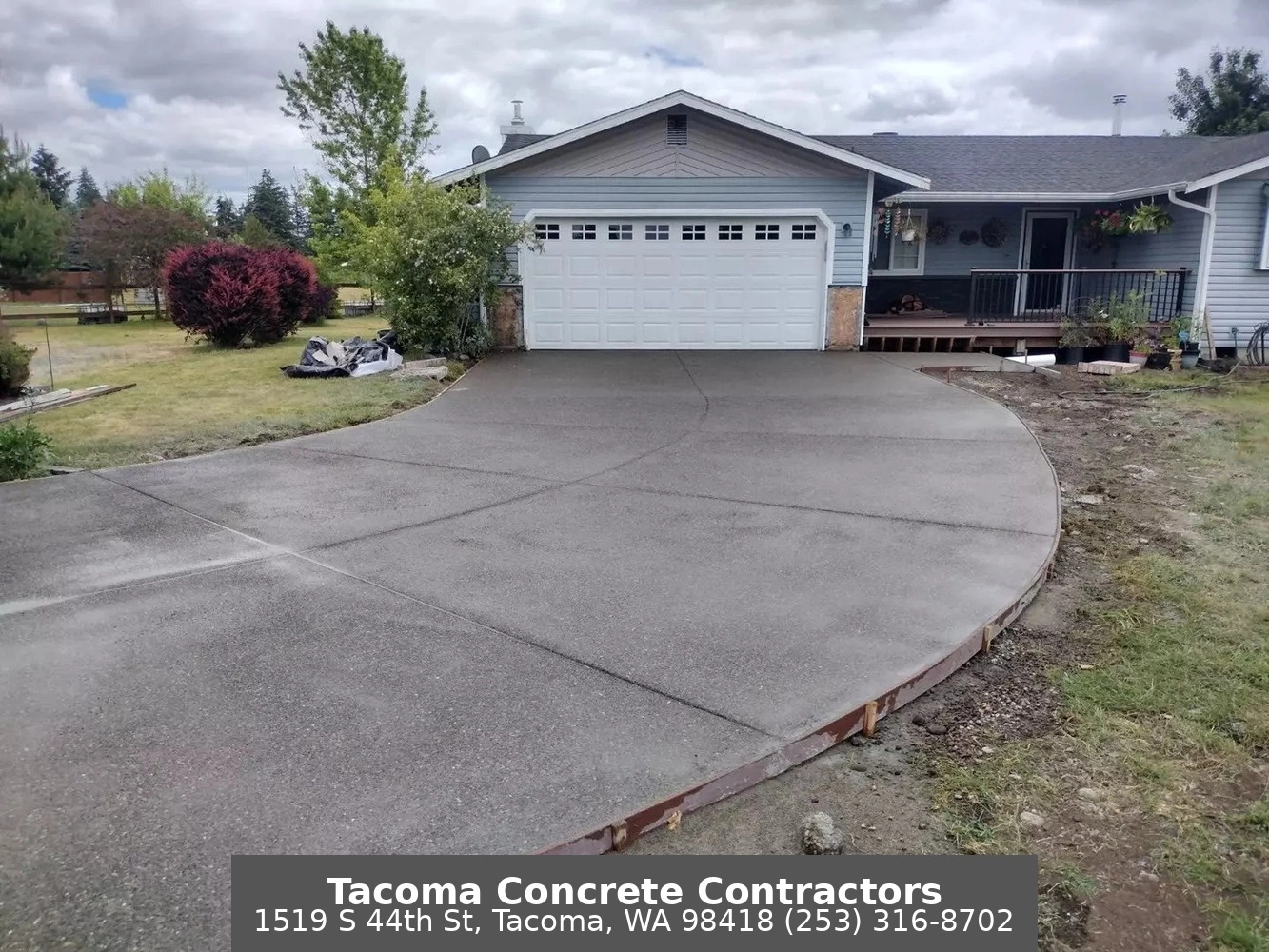
Understanding base behavior helps homeowners avoid unnecessary surface repairs.
How Proper Base Design Extends Slab Lifespan
A well-designed base reduces stress, slows deterioration, and keeps cracks tight and predictable.
This directly translates to longer service life and fewer repairs.
Mini Case Examples from Tacoma Projects
Slabs with well-compacted bases and good drainage often remain serviceable for decades. Slabs poured directly on disturbed soil frequently show settlement within a few years.
These patterns repeat consistently across Tacoma-area installations.
Why “Saving” on Base Prep Is Rarely a Savings
Base preparation is invisible after the pour, making it tempting to reduce scope.
However, base-related failures are among the most expensive to correct later.
Final Synthesis: The Ground Is the Real Structure
Concrete does not float—it depends entirely on what supports it. In Tacoma’s environment, soil behavior and drainage dictate performance.
When homeowners and contractors treat the ground as part of the structure, slabs perform predictably and last longer.
How Water Table Fluctuations Affect Slab Support
In some low-lying Tacoma areas, the groundwater table rises significantly during winter months. This reduces soil strength and increases the likelihood of settlement.
Proper base depth and drainage mitigate the effects of fluctuating water tables.
Why Slab Problems Often Appear After the First Few Winters
Early performance can be misleading. Slabs may look perfect during the first dry summer.
The first few wet seasons reveal whether the base and drainage were sufficient.
Homeowner Warning Signs of Base Issues
- New cracks after heavy rain Ponding water where none existed before Doors or gates scraping after slab movement
Planning for Unknown Future Conditions
Landscaping changes, added structures, or altered drainage patterns can affect subgrade behavior.
Robust base preparation provides tolerance for these unknowns.
Why Base Preparation Is the Quiet Difference Between Good and Great Concrete
Homeowners rarely see base work, but it determines whether concrete ages quietly or becomes a recurring problem.
In Tacoma’s environment, investing in what’s beneath the slab is one of the most reliable decisions a homeowner can make.
The Long View: Soil, Time, and Predictable Aging
Soil behavior is slow but relentless. Minor seasonal movement accumulates year after year.
Concrete supported by a well-prepared base accommodates this movement without visible distress.
Why Experienced Contractors Obsess Over What You Never See
Seasoned professionals know that visible workmanship matters less than invisible preparation.
They focus on excavation depth, compaction effort, and drainage details because those choices determine long-term success.
Final Homeowner Perspective
When evaluating concrete work, asking about what goes under the slab reveals more about quality than surface finish ever will.
In Tacoma, understanding the ground beneath your concrete is the key to avoiding disappointment years down the road.
Why Base Preparation Is a Regional Issue, Not a Generic One
Advice about concrete often ignores regional differences. Techniques that work in dry, sandy regions fail in the Pacific Northwest.
Tacoma’s rainfall, vegetation, and soil diversity demand region-specific base preparation strategies.
Connecting Slab Performance to Everyday Use
When slabs move, homeowners notice small inconveniences first: standing water, uneven steps, or cracking that catches debris.
These are early indicators of base-related movement.
Closing Summary
Concrete slabs succeed when soil, base, and drainage work together. In Tacoma, ignoring any one of these factors invites premature failure.
Treating the ground as part of the structure transforms concrete from a short-term surface into a long-term asset.
A slab that is properly supported rarely draws attention. It simply performs. That quiet reliability is the true goal of good concrete construction.
In practice, homeowners rarely regret investing in better base preparation, but many regret skipping it.
Tacoma Concrete Contractors
Phone: (253) 316-8702
Service Area: Tacoma, WA
Website: https://tacomaconcretecontractors.com/
Google Maps: https://maps.app.goo.gl/6izj2i3eSdA6KMxg6